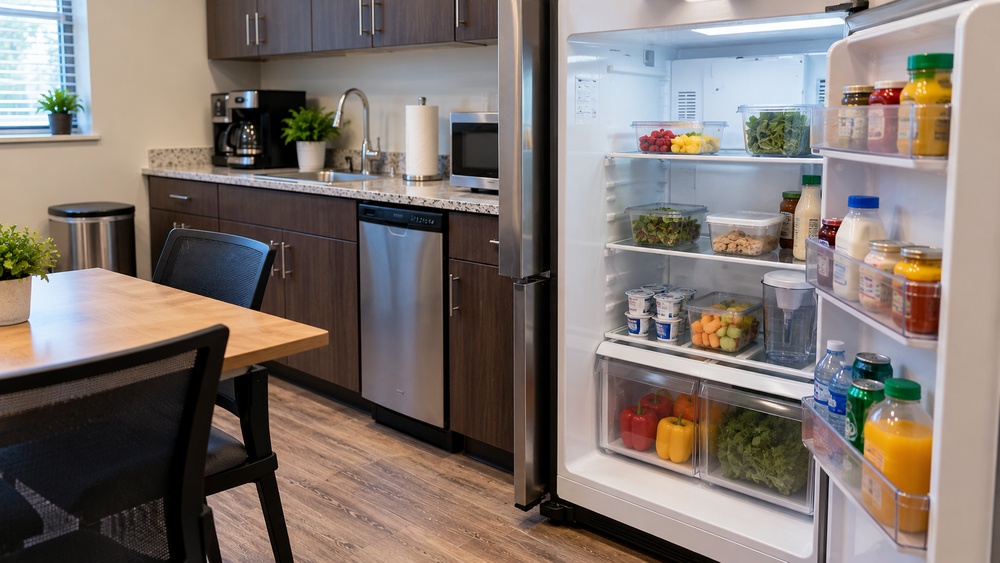
Every office has shared spaces.
The reception desk belongs to everyone who welcomes visitors. The conference room belongs to every meeting. The breakroom belongs to anyone who needs a coffee or a place to eat lunch.
And the refrigerator?
That belongs to everyone, too.
At least until it's time to clean it.
A Familiar Workplace Problem
Picture a small office in Marietta on a Friday afternoon.
Someone opens the breakroom refrigerator and discovers an old takeout container behind a carton of milk.
There's a sticky mark on the lower shelf and a little residue around the door handle.
Nobody remembers when the spill happened.
Nobody is sure whose container it is.
And everyone hopes someone else will handle it.
The problem isn't necessarily that the office has been neglected.
It's that shared equipment often needs a clear maintenance routine.
The First Rule: Clean Spills When They Happen
A fresh spill is usually easier to clean than one left to dry for several days.
When a container leaks or a drink spills, wipe the affected refrigerator surface promptly using a method approved by the appliance manufacturer.
For routine refrigerator cleaning, warm, soapy water is generally appropriate for many removable shelves and interior surfaces, followed by rinsing where appropriate and thorough drying.
Avoid abrasive products or strong chemicals that can damage surfaces or leave unwanted residues.
And don't forget the door gasket, exterior handle, and the area directly in front of the refrigerator.
These are frequently used parts of the breakroom.
A Simple Agreement for Shared Refrigerators
One useful approach is to make responsibility clear without making the process complicated.
During the week: Employees clean up their own spills and keep food in properly closed containers.
At the end of the week: A designated person checks the refrigerator according to the workplace's food-storage and disposal policy.
During scheduled cleaning: Approved interior and exterior surfaces receive the attention agreed upon in the cleaning plan.
Nobody should discard another employee's belongings without an established workplace policy.
A clear routine prevents confusion while keeping the shared space easier to maintain.
Cleanliness and Food Safety Aren't Exactly the Same
A refrigerator can look spotless while operating at the wrong temperature.
The FDA recommends keeping refrigerators at 40°F (4°C) or below to help protect perishable foods.
A refrigerator thermometer is a simple way to monitor that temperature.
Food-storage decisions should follow appropriate food safety guidance. Cleaning a shelf won't make improperly stored food safe to eat.
And if the refrigerator has mechanical problems, those require appliance maintenance rather than ordinary cleaning.
The Breakroom Makes a Quiet Impression
Employees use breakrooms repeatedly throughout the week.
Coffee spills near the machine. Crumbs gather around tables. Fingerprints appear on cabinet handles.
None of these is a major issue on its own.
But together, they influence how the workplace feels.
An effective commercial cleaning routine considers the surfaces that people actually use, not just the ones visitors see.
For offices and small businesses in Kennesaw, Marietta, and surrounding Metro Atlanta communities, those everyday details deserve consistent attention.
Orderly Spaces LLC provides professional commercial cleaning for offices and business spaces, with cleaning priorities established according to each property's needs.
Because a welcoming workplace isn't only about the lobby.
Sometimes, it's also about opening the breakroom refrigerator and finding a space that's been properly cared for.